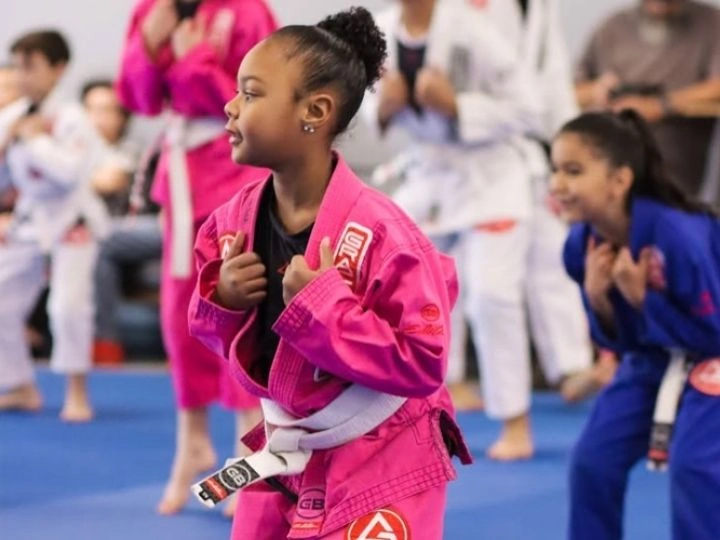
What Is the Kids BJJ Belt System?
Brazilian Jiu-Jitsu uses belts to represent a student’s progression.
The children’s system contains more belt colors than the adult system.
A simplified progression looks like:
White -> Gray -> Yellow -> Orange -> Green
Within some color groups, additional variations may be used as part of youth progression.
A belt should represent more than attendance. Instructors may look at technical development, consistency, understanding of positions, application, safety, focus, effort, behavior, respect, maturity, and overall development.
What Belt Does a Child Start With?
A new student begins at white belt.
They are not expected to arrive knowing how to grapple, tie a belt, or understand Jiu-Jitsu terminology.
[EXPLORE OUR KIDS JIU-JITSU PROGRAM]
What Are the Kids Jiu-Jitsu Belt Colors?
White Belt
The starting point. Children begin learning basic movement, safety, class behavior, fundamental positions, and introductory techniques.
Gray Belt
Gray represents an early step beyond the beginner stage.
Yellow Belt
Yellow represents continued development in technical understanding, awareness, control, and confidence.
Orange Belt
Orange is a more advanced youth rank. Students generally have significant mat experience.
Green Belt
Green is one of the highest youth belt groups before the transition toward the older teen/adult ranking structure.
The exact progression available to a child depends on age and the standards used by the academy or competition organization.
Why Are There More Belts for Kids Than Adults?
A child may start Jiu-Jitsu at a very young age and train for many years before entering the adult ranking system.
The youth system provides additional checkpoints so children can recognize meaningful progress along the way.
What Do Stripes Mean in Kids BJJ?
Many academies use stripes to recognize progress between belt promotions.
Think of a belt as a larger milestone and stripes as smaller checkpoints.
A stripe may recognize attendance, technique, effort, focus, behavior, consistency, or improvement.
The exact stripe system can vary by academy.
Why Are Stripes Useful for Children?
A year can feel enormous to a young child.
Stripes create shorter-term milestones and help children see: I am improving.
How Does the Gracie Barra Kids Belt System Work?
At Gracie Barra, kids training follows a structured approach designed to introduce children to Jiu-Jitsu in an age-appropriate environment.
Students build technical skills alongside discipline, respect, focus, consistency, cooperation, and responsibility.
Belts and stripes provide visible recognition along that journey, but the real goal is development.
How Does a Child Earn a New BJJ Belt?
Promotion is a coaching decision.
An instructor may consider technical understanding, application, consistency, safety, focus, attitude, respect, and maturity.
A good promotion should recognize development rather than simply reward the passage of time.
How Long Does It Take to Get the Next Belt?
There is no single timeline that accurately applies to every child.
Progress can depend on age, training frequency, technical development, attendance, maturity, academy standards, promotion structure, and eligibility for the next belt.
Should Parents Ask When Their Child Will Be Promoted?
You can ask how the promotion system works, but constantly asking when the next belt is coming can unintentionally change what the child thinks training is about.
Better questions include:
- What is my child improving at?
- What should they work on next?
- How is their focus?
- Are they participating well?
Should Kids Compare Their Belts?
Some comparison is natural, but children develop at different rates.
The better comparison is: How has my child changed since they started?
Is a Higher Belt Always Better at Fighting?
Belts represent development within a training system. They are not a perfect measurement of what will happen between two people in every physical situation.
Children differ in age, size, strength, athletic ability, experience, and competition background.
Do Kids Have to Compete to Get Promoted?
No.
Competition can be valuable for children who enjoy it, but kids can develop technique, confidence, discipline, fitness, coordination, self-defense skills, teamwork, and resilience without competing.
Can Competition Affect Development?
Competition can reveal how a child responds to pressure, which techniques they understand, and how they deal with winning and losing.
But one tournament result should not define a child’s progress.
What Should Parents Celebrate?
Belts deserve celebration, but parents can also celebrate focus, persistence, helping teammates, and handling difficult rounds well.
This reinforces the behaviors that eventually produce the belt.
What Happens When a Child Gets a New Belt?
A promotion creates new expectations as well as recognition.
More experienced children may begin taking greater responsibility for their own training, helping newer teammates, setting a good example, training safely, and demonstrating technique with greater control.
What Happens When Kids Become Teenagers?
The youth system eventually transitions toward the older teen and adult belt structure.
The exact transition depends on age, current rank, instructor evaluation, and the rules or standards being followed.
How Is the Adult BJJ Belt System Different?
The commonly recognized adult progression is White -> Blue -> Purple -> Brown -> Black.
The children’s system contains additional intermediate colors because young students can spend many years training before reaching adult ranks.
What Does a Belt Really Tell You?
A belt can tell you something about someone’s experience and progress, but it cannot perfectly measure character, confidence, effort, athleticism, courage, potential, or how supportive a teammate someone is.
How the Belt System Can Teach Patience
Real technical development takes time.
A child may practice the same movement repeatedly before becoming comfortable with it.
That teaches an important lesson: some worthwhile things take time.
How the Belt System Can Teach Resilience
Progress is not perfectly linear.
A child may have a great class one day and a difficult class the next. They may lose a competition or watch a teammate get promoted first.
The challenge is learning to continue.
How the Belt System Can Build Confidence
Healthy confidence can come from recognizing personal evidence of improvement.
A child remembers when they could not perform a movement. Months later, they can.
That experience shows them: I can learn difficult things.
What If My Child Is Not Getting Promoted Quickly?
Talk with the instructor.
There may be a specific technical area the child is developing, a maturity factor, inconsistent attendance, or simply different promotion standards.
The most useful question is: What can my child focus on to keep improving?
Should My Child Train More Often to Get Belts Faster?
Training consistently can help development, but increasing class frequency only to chase a promotion misses the point.
The best schedule is one your child and family can maintain.
[VIEW THE KIDS CLASS SCHEDULE]
Choosing a Kids Jiu-Jitsu School: Look Beyond Belts
A good belt system matters, but parents should not choose an academy simply because it promotes children quickly.
Look at age-appropriate classes, structured instruction, instructor communication, safety, environment, and whether promotions feel meaningful.
Kids Jiu-Jitsu at Gracie Barra Salt Lake City
At Gracie Barra Salt Lake City, the kids program is designed around structured, age-appropriate Jiu-Jitsu training.
Children can build technical skills while working on confidence, discipline, respect, focus, coordination, fitness, teamwork, and self-defense awareness.
What Should Parents Look for During a Trial Class?
Watch whether your child engages with the instructor, whether the class is organized, whether coaches are attentive, whether students train safely, and whether your child leaves wanting to come back.
Frequently Asked Questions About the Kids BJJ Belt System
What is the first belt in kids Brazilian Jiu-Jitsu?
White belt.
What are the main kids BJJ belt colors?
The primary youth color groups progress from white through gray, yellow, orange, and green.
What do stripes mean in kids Jiu-Jitsu?
Stripes are smaller progress markers used between belt promotions.
How long does it take a child to get a new BJJ belt?
There is no universal timeline. Age, attendance, technical progress, maturity, academy standards, and belt eligibility can all affect promotion timing.
Do kids have to compete to get promoted?
No.
What is the highest kids BJJ belt?
Green is the highest major youth color group before the transition into older teen/adult ranking structures.
The Belt Is a Milestone, Not the Destination
Children love earning belts, and they should.
A new belt represents effort, practice, challenges, learning, and progress.
But the most important changes may be happening where you cannot see them around your child’s waist.
Let Your Child Experience the First Step
If you are looking for kids Brazilian Jiu-Jitsu in Salt Lake City, come see the program in person.
Every journey starts with white.