Where Did Brazilian Jiu-Jitsu Come From?
Brazilian Jiu-Jitsu developed from Japanese grappling traditions introduced to Brazil during the early 20th century.
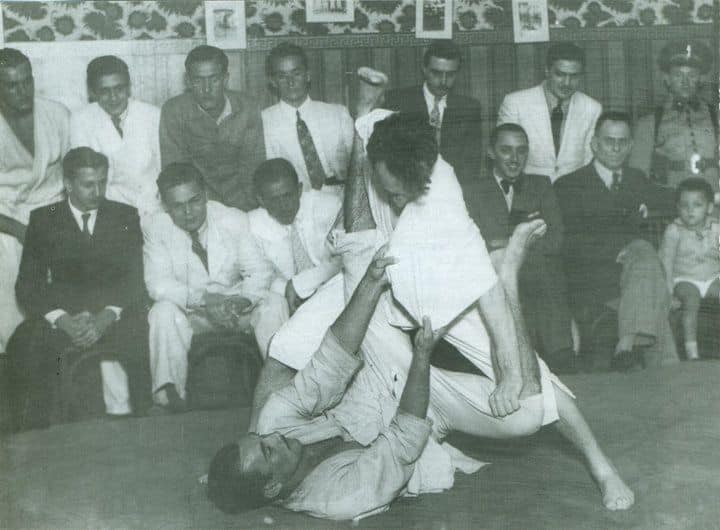
One important figure was Mitsuyo Maeda, a Japanese judoka who traveled internationally demonstrating and teaching grappling.
His time in Brazil became connected with the Gracie family and the development of the martial art that would eventually become known as Brazilian Jiu-Jitsu.
The Gracie Family and the Growth of Brazilian Jiu-Jitsu
Carlos Gracie and Helio Gracie became two of the most recognized early figures in the development of Brazilian Jiu-Jitsu.
Along with other members of the family, they helped establish academies, teach students, and demonstrate grappling.
Over time, BJJ moved far beyond Brazil and became a global sport and martial art.
Who Is Carlos Gracie Jr.?
Carlos Gracie Jr. grew up inside the Gracie family tradition.
He was the son of Carlos Gracie and trained under influential members of the family, including Rolls Gracie.
His contribution was not limited to teaching techniques. He also focused on how Jiu-Jitsu could be organized, taught, and expanded.
That vision eventually led to Gracie Barra.
When Was Gracie Barra Founded?
Gracie Barra was founded in 1986 by Carlos Gracie Jr.
The first school was established in the Barra da Tijuca area of Rio de Janeiro, Brazil.
The name “Gracie Barra” reflects that origin: Gracie from the family tradition and Barra from Barra da Tijuca.
Why Did Gracie Barra Grow?
One important reason is structure.
Gracie Barra developed a more standardized approach to teaching and school culture, helping create a recognizable student experience across different locations.
That includes:
- Structured classes
- Progressive learning
- Beginner fundamentals
- Training etiquette
- Uniform standards
- Instructor development
- Team identity
- Emphasis on safety
- Long-term progression
What Does “Jiu-Jitsu for Everyone” Mean?
One of the central ideas associated with Gracie Barra is Jiu-Jitsu for Everyone.
The philosophy expands Jiu-Jitsu beyond professional fighters and elite competitors.
A student might be a complete beginner, a child, a parent, a college student, a professional, a recreational athlete, a competitor, or someone interested in self-defense.
The Importance of a Structured Curriculum
For a beginner, Jiu-Jitsu can be overwhelming.
New students may not know where to stand, what a guard is, how to fall safely, how to escape, when to tap, or what techniques they should learn first.
A structured curriculum helps reduce that confusion.
Why Fundamentals Matter
Brazilian Jiu-Jitsu contains an enormous number of techniques.
Strong Jiu-Jitsu usually begins with fundamentals such as position, base, balance, posture, control, defense, escapes, leverage, and timing.
A structured beginner program gives students time to build that foundation.
From One Academy to a Global Team
As Gracie Barra expanded, students of Carlos Gracie Jr. and later generations of instructors established schools in new communities.
Today, Gracie Barra reports more than 1,000 schools worldwide.
That scale creates something unusual in martial arts: a student can belong to a local academy while also being connected to a much larger global network.
What Is the Gracie Barra Red Shield?
The red shield is one of the most recognizable symbols associated with Gracie Barra.
For students, it creates a shared identity between schools while local academies maintain their own communities.
Brotherhood, Integrity and Development
Gracie Barra identifies three core values: Brotherhood, Integrity, and Development.
Brotherhood
Jiu-Jitsu cannot be learned alone. You need instructors, training partners, and teammates.
Integrity
Training requires trust. When someone taps, you stop. Respect and responsibility are essential.
Development
Everyone is developing. The white belt develops. The instructor develops. Even experienced black belts continue learning.
Gracie Barra and Competition
Competition has played an important role in Brazilian Jiu-Jitsu history.
Gracie Barra has produced many competitors and maintains a competitive tradition, but students do not need to compete to be legitimate practitioners.
Gracie Barra and MMA
Brazilian Jiu-Jitsu became much more visible internationally through mixed martial arts, particularly during the early development of the UFC.
However, modern BJJ is much larger than MMA. Most students are not preparing for professional fighting.
They may want to learn a martial art, get in shape, develop self-defense skills, challenge themselves, or find a community.
What Does Gracie Barra History Mean for a Beginner Today?
History matters only if the system created from it improves the student’s experience today.
A beginner should have a clear starting point, structured instruction, coaches who understand new students, safe training partners, and a progression from fundamentals to more advanced material.
Why School Culture Matters
The name on the building is not enough.
A good Jiu-Jitsu school needs a healthy local culture created every day by instructors, staff, experienced students, beginners, parents, competitors, and recreational students.
Gracie Barra in Salt Lake City
The history of Gracie Barra began in Brazil, but for students in Utah, the part that matters most happens locally.
Gracie Barra Salt Lake City brings the Gracie Barra training system into a local academy where students can learn Brazilian Jiu-Jitsu through programs designed for different ages and experience levels.
[EXPLORE OUR JIU-JITSU PROGRAMS]
What Should You Expect From Gracie Barra Salt Lake City?
Look at the instructors, program structure, schedule, students, facility, and culture.
Can you imagine training there for several years?
Those factors matter more to your daily experience than history alone.
Do You Need Experience to Train at Gracie Barra?
No. The entire point of beginner training is to teach people who do not yet know Jiu-Jitsu.
Can Kids Train at Gracie Barra?
Yes. Kids programs are an important part of the Gracie Barra training model.
Children can learn age-appropriate Brazilian Jiu-Jitsu while developing coordination, focus, discipline, confidence, teamwork, respect, and self-defense awareness.
Can Adults Start Jiu-Jitsu Later in Life?
Yes. Adults start at many different ages and can train for fitness, self-defense, challenge, recreation, or competition.
Experience the Legacy Instead of Just Reading About It
Gracie Barra’s history began decades ago in Brazil, but Jiu-Jitsu is experienced on the mat.
You learn one position, one escape, one technique, then another.
If you are in Salt Lake City and curious about Brazilian Jiu-Jitsu, the easiest next step is to experience a class.
Frequently Asked Questions About Gracie Barra
When was Gracie Barra founded?
Gracie Barra was founded in 1986 by Master Carlos Gracie Jr. in Brazil.
Where did the name Gracie Barra come from?
“Gracie” reflects the Gracie family tradition, while “Barra” refers to Barra da Tijuca in Rio de Janeiro.
Who founded Gracie Barra?
Carlos Gracie Jr.
How many Gracie Barra schools are there?
Gracie Barra currently reports more than 1,000 schools around the world.
What does “Jiu-Jitsu for Everyone” mean?
It reflects the idea that Brazilian Jiu-Jitsu can be taught to people with different ages, backgrounds, experience levels, and goals.
What are the Gracie Barra values?
Brotherhood, Integrity, and Development.
Is Gracie Barra only for competitors?
No. Students train for recreation, fitness, self-defense, personal development, and competition.
Can beginners train at Gracie Barra Salt Lake City?
Yes. Complete beginners can begin without previous martial arts experience.
From Rio de Janeiro to Salt Lake City
The story of Gracie Barra began with one school in Brazil.
Today, a student’s own journey can begin much more simply: with a first class.
[BOOK A FREE CLASS AT GRACIE BARRA SALT LAKE CITY]