What Should a BJJ Beginner Learn First?
Before worrying about submissions, beginners should learn how to move efficiently, maintain balance and posture, recognize major positions, protect themselves, escape bad positions, control distance, use frames, understand guard, improve position before attacking, tap safely, and train with controlled resistance.
Technique #1: The Hip Escape, or Shrimp
The hip escape, commonly called shrimping, teaches students to create space by moving the hips away from pressure.
It appears in side-control escapes, guard recovery, mount escapes, and many defensive movements.
Technique #2: The Bridge
The bridge uses the legs and hips to lift and redirect weight.
It can help disrupt balance, create movement under mount, begin escapes, and generate space.
Technique #3: The Technical Stand-Up
The technical stand-up teaches students how to return to their feet while maintaining balance and protecting themselves.
It reinforces distance, structure, and safe movement.
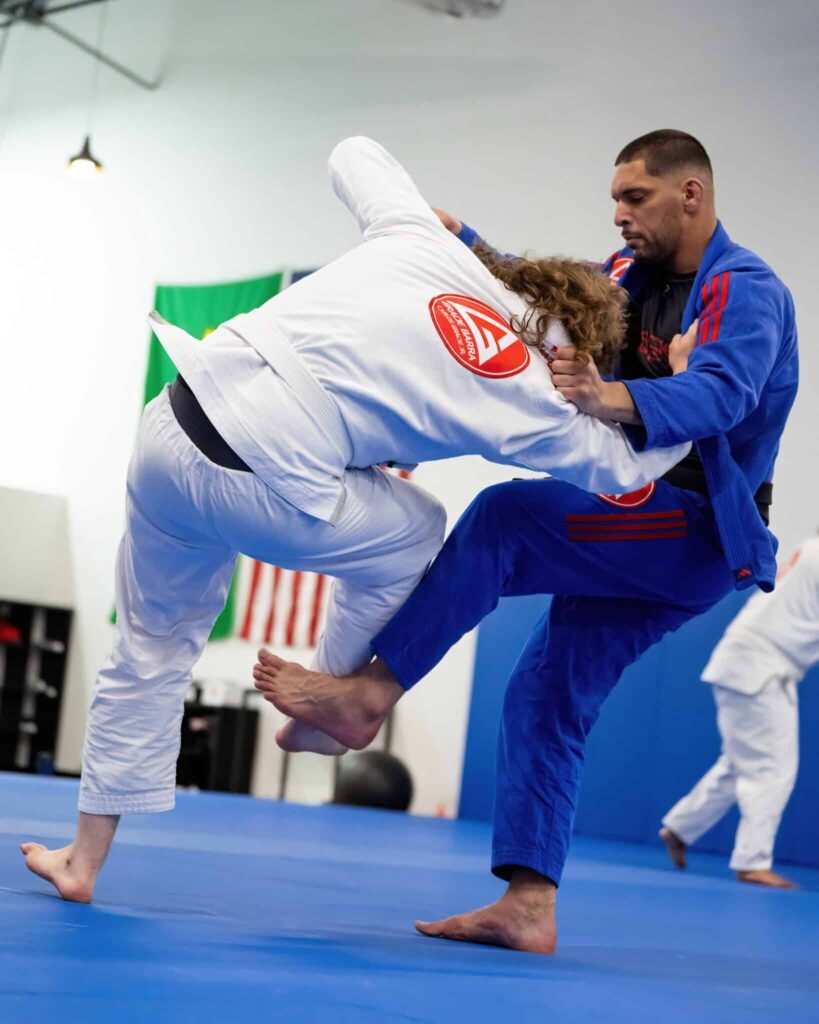
Technique #4: Breakfalls
Beginners should learn how to fall safely.
Takedowns are part of Brazilian Jiu-Jitsu, so becoming comfortable moving between standing and ground positions is important.
Breakfalls should be learned under qualified supervision.
Understand Position Before Submission
Beginners should learn to recognize mount, side control, back control, closed guard, open guard, half guard, and standing positions.
Before learning dozens of attacks, ask: Where am I? Is this a good position or a bad position? What should my priority be here?
Technique #5: Mount Escapes
Beginners learn concepts such as protecting vulnerable areas, keeping elbows in safer positions, controlling posture, bridging, creating space, and recovering guard.
The important lesson is: do not panic. First defend, then create space, then escape.
Technique #6: Side-Control Escapes
Side-control escapes teach frames, hip movement, elbow position, knee position, timing, and space creation.
They also teach a crucial lesson: create structure before trying to move.
What Are Frames in Jiu-Jitsu?
A frame is a structure created with your arms or legs that helps manage pressure and maintain space.
Instead of trying to hold someone away through muscular strength alone, you use skeletal structure and positioning more efficiently.
Technique #7: Guard Retention
Guard retention teaches the bottom student how to keep their legs involved and prevent the top person from easily progressing into a dominant position.
Technique #8: The Closed Guard
Closed guard gives beginners a relatively structured position from which to learn posture control, distance, breaking balance, sweeps, and basic submissions.
Technique #9: A Basic Sweep
A sweep allows the guard player to reverse the position and come on top.
It teaches breaking balance, removing posts, controlling direction, timing, and leverage.
Technique #10: Guard Passing
Guard passing teaches posture, balance, distance, hip control, knee position, pressure, and movement.
You do not need five different passes in your first month. One or two reliable concepts practiced repeatedly can teach you far more.
Technique #11: Maintaining Side Control
Once you reach a good top position, you need to learn how to keep it.
Side control teaches weight distribution, base, pressure, hip control, and how to respond when your partner creates space.
Technique #12: Maintaining Mount
Getting mount is useful. Being able to stay there is another skill entirely.
Learn to become comfortable in the position before rushing toward an attack.
Technique #13: Back Control
Back control reinforces staying connected, controlling the hips, maintaining position, preventing rotation, and attacking without sacrificing control.
When Should Beginners Learn Submissions?
Submissions are an important part of BJJ, but they become much more effective when you understand the position from which they are applied.
Commonly introduced submissions include the armbar, triangle choke, and rear naked choke.
The Armbar
The armbar teaches body positioning, hip control, limb isolation, posture breaking, and controlled application of a joint lock.
The Triangle Choke
The triangle introduces angles, posture control, leg positioning, distance, and timing.
The Rear Naked Choke
The rear naked choke commonly connects to back control and reinforces a fundamental sequence: first earn the position, then maintain it, then attack.
Takedowns for BJJ Beginners
BJJ does not exist only on the ground.
Beginners should gradually learn how to maintain a safe stance, control distance, grip appropriately, break balance, enter takedowns safely, defend takedowns, and fall correctly.
The Most Important BJJ Technique May Be Defense
Beginners often ask what submission they should learn first.
A better question may be: How do I stop getting caught?
Defense teaches you to recognize danger and makes Jiu-Jitsu feel less chaotic.
Learning to Tap Is a Technique Too
Tapping is how you communicate that a submission has reached the point where training should stop.
Tap. Reset. Ask what happened. Try again.
Why You Should Not Learn BJJ From YouTube Alone
Videos can be useful, but they cannot give you physical feedback, corrective coaching, resistance, partner timing, pressure, or safety supervision.
Brazilian Jiu-Jitsu has to be felt.
How Many Techniques Should a Beginner Know?
Technique count is less important than having basic answers for common positions.
When underneath mount: how do I stay safe and escape?
When underneath side control: how do I create space?
When playing guard: how do I control distance?
When on top: how do I maintain balance?
How BJJ Techniques Are Actually Learned
Learning usually follows a cycle:
- Instruction
- Drilling
- Correction
- Resistance
- Live training
- Reflection
What Is the GB1 Fundamentals Program?
At Gracie Barra Salt Lake City, new adult students can begin through the GB1 Fundamentals Program.
The purpose of fundamentals training is to develop the core skills that later BJJ depends on.
Do I Need to Memorize Techniques Before My First Class?
Absolutely not. Your first job is simply to arrive willing to learn.
Do I Need to Be Athletic?
No. People begin BJJ with very different physical backgrounds.
How Often Should Beginners Practice Techniques?
Consistency beats occasional intensity.
A beginner who trains two or three times every week repeatedly encounters the same movements and concepts.
Common Technique Mistakes BJJ Beginners Make
- Trying to learn everything
- Prioritizing submissions over escapes
- Using strength instead of technique
- Moving too fast during drilling
- Ignoring position
- Training only with one partner
- Expecting immediate mastery
Brazilian Jiu-Jitsu Techniques for Self-Defense
Useful BJJ concepts for self-defense include maintaining balance, managing close contact, escaping holds, controlling distance, getting back to your feet, protecting yourself from bad positions, and controlling another person when necessary.
Awareness and avoidance remain important.
Learn BJJ Techniques in Salt Lake City
Eventually, an article can only take you so far.
Brazilian Jiu-Jitsu is learned by physically practicing with another person. You need to feel balance, pressure, timing, resistance, and movement.
At Gracie Barra Salt Lake City, complete beginners can learn those fundamentals through structured classes instead of trying to piece together random techniques online.
Frequently Asked Questions About BJJ Techniques for Beginners
What are the first BJJ techniques I should learn?
Focus on fundamental movements, positional awareness, defense, escapes, guard, passing, control, and a small number of submissions.
Should beginners learn submissions or escapes first?
Both matter, but defense and escapes give beginners a stronger foundation.
What is shrimping in BJJ?
Shrimping, or the hip escape, is a fundamental movement used to create space and reposition the hips.
What are good beginner BJJ submissions?
Commonly introduced submissions can include the armbar, triangle choke, and rear naked choke.
Should beginners learn takedowns?
Yes, progressively and under qualified instruction.
Can I learn BJJ techniques at home?
You can study concepts, but partner feedback, resistance, coaching, and safety supervision are essential to actually learning BJJ.
Stop Collecting Techniques. Start Building a Foundation.
There will always be another Brazilian Jiu-Jitsu technique to learn.
The beginning should be simpler: learn how to move, protect yourself, understand position, escape, develop control, add a few reliable attacks, and keep showing up.