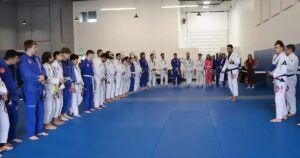
What Does BJJ Mean?
BJJ stands for Brazilian Jiu-Jitsu.
You may also see it written as Brazilian Jiu Jitsu, Brazilian Jiu-Jitsu, Jiu-Jitsu, Jiu Jitsu, or BJJ.
The word Jiu-Jitsu is commonly translated in relation to the idea of a “gentle art.” That does not mean training is effortless. Instead, the concept reflects an emphasis on technique, leverage, positioning, and timing rather than relying entirely on brute force.
What Is Brazilian Jiu-Jitsu?
At its core, Brazilian Jiu-Jitsu is a martial art focused on grappling.
Grappling means controlling and maneuvering another person through physical contact rather than primarily using strikes.
Training may include takedowns, throws, clinch positions, pins, escapes, guard positions, sweeps, guard passing, joint locks, chokes, and positional control.
Students first learn techniques with cooperative partners. As their skills develop, they begin practicing those techniques against increasing levels of resistance.
Is Brazilian Jiu-Jitsu a Martial Art or a Sport?
It is both.
Brazilian Jiu-Jitsu can be practiced as a martial art, combat sport, form of self-defense training, recreational activity, or competitive sport.
Where Did Brazilian Jiu-Jitsu Come From?
Brazilian Jiu-Jitsu developed in Brazil through the adaptation and continued development of Japanese grappling systems.
The Gracie family became closely associated with the development and popularization of the art.
Modern BJJ continues to evolve through competition, wrestling, judo, submission grappling, and technical innovation.
Why Is Brazilian Jiu-Jitsu Different From Other Martial Arts?
One of the clearest differences is the focus on grappling.
Boxing focuses primarily on punches. Kickboxing incorporates punches and kicks. Brazilian Jiu-Jitsu focuses much more heavily on controlling another person, escaping control, ground positions, takedowns, submissions, and grappling strategy.
What Is the Goal of BJJ?
In competitive Brazilian Jiu-Jitsu, the objective may be to win through submission, points, or other criteria depending on the ruleset.
During everyday training, the broader goal is learning.
A useful beginner sequence is:
- Stay safe.
- Improve your position.
- Establish control.
- Create an attacking opportunity.
- Apply a submission when appropriate.
This leads to an important concept: position before submission.
What Is a Submission?
A submission is a technique designed to make a training partner or opponent concede the position.
Joint Locks
Examples include armbars, Kimuras, Americanas, and certain leg locks.
Chokes
Examples include the rear naked choke, triangle choke, and collar chokes.
During training, students communicate submission by tapping. When someone taps, the technique stops immediately.
What Is the Guard in BJJ?
The guard is one of Brazilian Jiu-Jitsu’s defining concepts.
A student can be underneath another person while still using their legs, grips, movement, and positioning to control distance and create attacks.
Common beginner guards include closed guard, open guard, and half guard.
What Is Mount?
Mount is a dominant position where one student controls another from above the torso.
For the person underneath, the priorities are usually staying safe, maintaining good defensive position, creating space, and escaping.
What Is Side Control?
Side control is a top position where one student controls another from the side.
Beginners gradually learn to use frames, hip movement, timing, position, and space creation rather than simply trying to push the other person away with strength.
What Is Back Control?
Back control is a strong position in which the controlling student is behind their partner.
It teaches an important lesson: maintaining a position is a skill of its own.
What Is a Sweep?
A sweep allows a student playing guard to reverse the position and come on top.
Sweeps demonstrate how balance, leverage, angle, and control can create positional change.
What Is Guard Passing?
If one person is using guard, the other person’s goal may be to get around the legs and establish a stronger top position. That process is called passing the guard.
What Does Leverage Mean in BJJ?
Leverage means using body positioning, angles, mechanical advantage, timing, and weight distribution to make movement more efficient.
Strength, size, and athleticism still matter, but technique can help someone use their physical abilities much more effectively.
What Is Rolling in Brazilian Jiu-Jitsu?
Rolling is the term commonly used for live BJJ sparring.
Two students practice against each other while both are actively trying to improve position, defend, escape, or submit.
Live resistance helps students learn timing, reactions, decision-making, adaptation, energy management, and positional awareness.
Is Rolling the Same as Fighting?
No. Training partners are there to help each other improve.
The objective of rolling in class is not to injure or dominate your teammate.
What Does a Brazilian Jiu-Jitsu Class Look Like?
A typical class may include warm-up or movement, technique instruction, drilling, positional training, and rolling depending on the experience level and class structure.
Beginner programs may introduce these stages progressively.
Gi vs No-Gi Brazilian Jiu-Jitsu
Gi Jiu-Jitsu
Students wear the traditional Jiu-Jitsu uniform known as the gi. The fabric can be used for grips and certain techniques.
No-Gi Jiu-Jitsu
Students typically wear grappling shorts or leggings and a rashguard. Because there is no gi fabric to grip, movement and control strategies can feel different.
Both are Brazilian Jiu-Jitsu.
Is Brazilian Jiu-Jitsu Good for Beginners?
Yes. You do not need previous martial arts experience before starting BJJ.
A good beginner program should assume that you do not know the positions, terminology, movement, falling mechanics, escapes, tapping, or rolling.
Do I Need to Get in Shape Before Starting BJJ?
No.
Your first classes may be tiring. You may use too much strength or move inefficiently. That is normal.
As you train consistently, your body can gradually adapt.
What Physical Skills Can BJJ Develop?
Regular training can challenge cardiovascular endurance, coordination, balance, mobility, grip strength, core stability, muscular endurance, and body awareness.
Is Brazilian Jiu-Jitsu Good for Self-Defense?
BJJ can develop useful skills for physical self-defense, particularly in close-contact grappling situations.
Training may help students become more familiar with balance, escapes, controlling another person, creating space, getting back to their feet, and functioning under resistance.
Awareness, avoidance, communication, and leaving dangerous situations whenever possible are also important.
Is Brazilian Jiu-Jitsu Effective Against Bigger People?
BJJ emphasizes leverage, timing, and positioning, which can help someone manage differences in strength and size.
But size and strength remain advantages. Technique does not make physical differences disappear.
Is Brazilian Jiu-Jitsu Dangerous?
BJJ is a contact sport, so injuries can happen.
A responsible academy manages risk through qualified instruction, controlled training, clear tapping rules, progressive teaching, appropriate partner selection, clean facilities, and safe technique selection.
Is BJJ Good for Kids?
Brazilian Jiu-Jitsu can provide children with structured physical activity while introducing coordination, focus, discipline, confidence, teamwork, body awareness, problem-solving, and self-defense awareness.
Can Women Train Brazilian Jiu-Jitsu?
Absolutely. Women train and compete in Brazilian Jiu-Jitsu at every level.
Am I Too Old to Start Brazilian Jiu-Jitsu?
Adults begin BJJ at many different ages.
Your training frequency and intensity can reflect your age, conditioning, goals, recovery, experience, and injury history.
Do I Need to Compete?
No. Competition is optional for recreational students.
How Does the BJJ Belt System Work?
The commonly recognized adult belt progression is White -> Blue -> Purple -> Brown -> Black.
Children have a more extensive youth belt system.
Promotion standards vary between academies and instructors.
How Long Does It Take to Get Good at BJJ?
There is no universal timeline.
Progress depends on training frequency, coaching, consistency, physical background, learning style, experience, and individual goals.
Is Brazilian Jiu-Jitsu Hard to Learn?
At first, BJJ can be confusing.
You are learning new movements, terminology, positions, and physical reactions.
Start with basic movement, position, defense, escapes, control, and simple attacks.
What Should a BJJ Beginner Focus On?
Focus on learning how to tap, understanding major positions, staying calm, escaping mount and side control, understanding guard, protecting your neck and arms, using frames, moving your hips, controlling your breathing, and training consistently.
What Should I Wear to My First BJJ Class?
Ask the academy before arriving.
For Gi training, students use a Jiu-Jitsu uniform. For No-Gi, students typically wear grappling-specific athletic clothing.
Is BJJ the Same as Judo?
No. They share historical connections and overlapping grappling concepts, but developed into different sports and training systems.
Is BJJ the Same as Wrestling?
No. Wrestling strongly emphasizes takedowns, control, and pinning. BJJ includes takedowns and control but also a large submission system and extensive use of guard positions.
Is BJJ the Same as MMA?
No. MMA combines multiple fighting disciplines, including striking and grappling. Brazilian Jiu-Jitsu is one martial art that can form part of an MMA fighter’s skill set.
Why Do People Keep Training BJJ?
People may start for fitness or self-defense, then become fascinated by technique, friendships, competition, or personal development.
There is always another position, detail, reaction, or problem to solve.
What Should You Look for in a Brazilian Jiu-Jitsu School?
Look for structured beginner instruction, qualified coaches, safe training culture, clean facilities, a practical schedule, programs that match your goals, and a community you feel comfortable joining.
Brazilian Jiu-Jitsu in Salt Lake City
If you are researching BJJ because you are thinking about training, there comes a point when reading more definitions stops being useful.
You need to feel what Jiu-Jitsu is like.
At Gracie Barra Salt Lake City, complete beginners can start learning Brazilian Jiu-Jitsu through structured training designed to build fundamentals progressively.
Frequently Asked Questions About Brazilian Jiu-Jitsu
What does BJJ stand for?
BJJ stands for Brazilian Jiu-Jitsu.
What is Brazilian Jiu-Jitsu in simple terms?
Brazilian Jiu-Jitsu is a grappling-based martial art that teaches positioning, control, escapes, takedowns, and submissions using technique and leverage.
Does BJJ have punching and kicking?
Standard Brazilian Jiu-Jitsu training generally focuses on grappling rather than regular punches and kicks.
Is BJJ good for beginners?
Yes. Complete beginners can start without previous martial arts experience.
Do I need to be strong to learn BJJ?
No. Strength can help, but BJJ places major emphasis on technique, timing, positioning, and leverage.
Do you have to compete in BJJ?
No.
What is rolling in BJJ?
Rolling is live grappling practice where training partners apply their techniques against active resistance.
What does tapping mean?
Tapping tells your partner to stop applying a submission.
Can children train Brazilian Jiu-Jitsu?
Yes. Children’s programs can adapt BJJ techniques and class structure for different age groups.
You Understand What BJJ Is. Now Experience It.
You can understand the definition of Brazilian Jiu-Jitsu in a few minutes. Learning it is different.
You need to feel what balance, pressure, timing, leverage, and resistance actually mean.
If you are in Salt Lake City and have been wondering whether BJJ is right for you, the next step is simple: try it.
[BOOK A FREE BRAZILIAN JIU-JITSU CLASS]
No experience required. Start where you are.