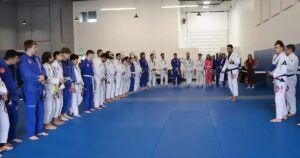
What Is Brazilian Jiu-Jitsu for Kids?
Brazilian Jiu-Jitsu is a grappling-based martial art. Instead of focusing mainly on punching and kicking, children learn how to use movement, positioning, balance, leverage, and control.
Age-appropriate classes can include:
- Basic movement
- Balance and coordination
- Safe falling skills
- Positional control
- Escapes
- Guard concepts
- Takedown fundamentals
- Controlled partner drills
- Games that reinforce Jiu-Jitsu skills
What Are the Benefits of Brazilian Jiu-Jitsu for Kids?
Confidence Built Through Real Skills
Healthy confidence can come from learning something that was difficult, practicing it, and eventually being able to do it.
A child may remember when they could not perform an escape or felt nervous working with a partner. Weeks or months later, that same skill may feel natural.
Discipline Without Expecting Perfection
Jiu-Jitsu asks children to follow instructions, respect training partners, wait their turn, and keep trying when a technique is difficult.
The value comes from practicing those habits repeatedly.
Improved Focus
A technique has details. If children stop paying attention, the movement becomes harder to perform. That creates a practical reason to focus.
Physical Activity With a Purpose
Jiu-Jitsu can challenge coordination, balance, mobility, strength, cardiovascular endurance, and body awareness while giving the child a problem to solve.
Learning to Handle Challenges
Children will sometimes struggle in class. They may not understand a technique immediately, or a partner may escape.
Those moments create opportunities to practice persistence.
Teamwork and Respect
Jiu-Jitsu cannot be learned alone. Children need partners who allow them to practice safely. They learn that their teammate’s safety matters and that everyone improves together.
Can Jiu-Jitsu Help Kids With Bullying?
BJJ can help children become more comfortable with physical contact, learn how to protect themselves in grappling situations, and develop confidence through training.
But martial arts should not teach children that physical confrontation is the first solution.
A responsible program should reinforce:
- Awareness
- Communication
- Boundaries
- De-escalation
- Walking away when possible
- Seeking help from trusted adults
The goal is not to make children eager to fight. It is to help them become more capable, composed, and confident.
[EXPLORE KIDS JIU-JITSU]
Is Brazilian Jiu-Jitsu Safe for Kids?
Brazilian Jiu-Jitsu is a contact activity, so no responsible school should claim there is zero risk of injury.
Safety depends heavily on how classes are taught.
Parents should look for:
- Age-appropriate techniques
- Active instructor supervision
- Controlled partner drills
- Clear rules about tapping
- Appropriate partner matching
- Clean facilities
- A culture that values control over aggression
Young children should not simply be treated as small adults.
What Happens in a Kids BJJ Class?
A children’s Jiu-Jitsu class may include warm-up and movement, technique instruction, partner practice, structured games or positional training, and clear expectations around listening, respect, effort, and taking care of teammates.
The best kids classes feel organized without removing the enjoyment of being a child.
What Age Can Kids Start Brazilian Jiu-Jitsu?
There is no single age that is right for every child.
Readiness can depend on ability to follow simple instructions, comfort participating without a parent on the mat, basic communication, interest in the activity, and emotional maturity.
Parents should ask how the academy separates age groups and what is expected in the youngest class.
Does My Child Need Martial Arts Experience?
No. Kids programs should be able to introduce complete beginners progressively.
Is Jiu-Jitsu Good for Shy Kids?
It can be. A supportive environment can allow shy children to participate gradually and become more comfortable with teammates and instructors over time.
The goal is not to force a child to become an extrovert. It is to help them become more comfortable and confident in the environment.
Is Jiu-Jitsu Good for Highly Energetic Kids?
Jiu-Jitsu can give energetic children a structured way to move. They are asked to use energy while also paying attention to rules, technique, and partner safety.
BJJ vs Other Martial Arts for Kids
There is no single martial art that is best for every child.
One major characteristic of BJJ is that students can practice techniques against resistance without making regular punching and kicking the center of training.
For some families, that makes grappling especially appealing.
How to Choose a Kids Jiu-Jitsu School
Look at Age Groups
A preschool-age child and a teenager should not be taught exactly the same way.
Ask How Beginners Start
There should be a clear introduction for children with no previous experience.
Watch the Instructors
Do they communicate clearly? Are they attentive? Do they know how to keep children engaged while maintaining control?
Observe Safety
Watch partner matching, supervision, and how instructors respond when children become overly competitive or physical.
Look at the Culture
Do experienced students help new students? Are children corrected respectfully? Is discipline present without humiliation?
Check the Schedule
A program only works if your family can attend consistently.
Kids Jiu-Jitsu in Salt Lake City
For families in Salt Lake City, the best way to evaluate a children’s martial arts program is to experience it in person.
At Gracie Barra Salt Lake City, kids can begin Brazilian Jiu-Jitsu through age-appropriate training designed to build a foundation over time.
Your child does not need previous martial arts experience.
What Should My Child Wear to the First Class?
Requirements can vary depending on the academy and class. Before arriving, ask the school what your child should wear and whether equipment is provided for an introductory class.
Does My Child Have to Compete?
No. Competition can be valuable for children who enjoy it, but kids can benefit from Jiu-Jitsu through recreational training.
A child can develop technique, coordination, confidence, fitness, discipline, and friendships without ever entering a competition.
How Often Should Kids Train Jiu-Jitsu?
There is no universal number. The right frequency depends on age, school schedule, other activities, recovery, family routine, and the child’s enthusiasm.
Consistency matters more than forcing an extreme schedule.
How Do I Know if My Child Likes BJJ?
Do not judge only by whether they perform well during the first class.
Look at their response. Do they engage with the instructor? Do they participate? Do they ask about going back? Do they talk about something they learned?
Some children immediately love the mat. Others need several classes before they feel comfortable.
Frequently Asked Questions About BJJ for Kids
Is Jiu-Jitsu good for kids?
It can be a valuable physical and technical activity when taught through an age-appropriate, well-supervised program.
Is BJJ safe for children?
BJJ is a contact sport with injury risk, but responsible coaching, appropriate techniques, partner matching, supervision, and clear safety rules help manage that risk.
Will BJJ make my child aggressive?
A well-run program should teach control, respect, safety, and appropriate use of martial arts rather than encouraging unnecessary aggression.
Can BJJ help my child build confidence?
Children can develop confidence by learning skills, overcoming challenges, and seeing evidence of their own improvement over time.
Can Jiu-Jitsu help with bullying?
BJJ can help children become more comfortable with physical pressure and learn grappling skills, but a responsible approach should also emphasize avoidance, communication, boundaries, and seeking adult help.
Does my child need to compete?
No. Competition is optional.
Let Your Child Experience the Program
Parents can research benefits, belts, safety, and techniques online. But the most useful question is often simpler:
How does my child respond to the actual class?
Visit the academy. Meet the instructors. Watch the environment. Let your child experience Jiu-Jitsu.
Then decide whether the program feels right for your family.
Book a free kids Jiu-Jitsu class at Gracie Barra Salt Lake City and see how your child responds.